
Monero - True Digital Cash
TL;DR: Monero - low fees, privacy by default, possible anonymity, real decentralization. Very practical for shops, customers and other money transfers.
We all use cryptocurrency. For most of us, the most convenient ones are btc, eth, usdt. But what if these cryptocurrencies are not entirely secure and not exactly what we need?
Cryptocurrency from Greek kryptós, “hidden” or “secret”, so why don’t the most popular cryptocurrencies provide anonymity or even decentralization? It's no secret that cryptocurrency is used as offshore money without government and in defense of freedom. So I think we don't want all our transactions to be public and traceable.
Monero, usually known by its ticker XMR, is built around one specific idea: digital cash should behave like cash. It should be private by default, difficult to censor, resistant to surveillance.
The problem: transparent money is not private money
 On Bitcoin or Ethereum, a wallet address does not directly show a legal name, but once an address is connected to a person, exchange account, business, donation page, domain, or invoice, the entire transaction history can become readable.
That creates several problems:
- Anyone can inspect balances.
- Payments can reveal commercial relationships.
- Past transactions can follow coins forever.
- Exchanges and analytics companies can blacklist “tainted” funds.
- Users can be profiled by governments, companies, criminals, or competitors.
This is not how physical cash works. When you hand someone a banknote, the recipient does not automatically learn your full financial history. Future users of the note do not inherit a permanent visible record of every previous owner.
Monero is designed to restore that cash-like property in digital form.
Solution: Privacy by default
Every Monero transaction hides three critical pieces of information:
- Who received the funds
- Who sent the funds
- How much was sent
Monero makes this simple for ordinary users. Anyone can use a native XMR wallet and control their own funds directly, without relying on an exchange or custodial wallet. When crypto is kept on an exchange, it is not truly yours: the exchange decides when withdrawals are allowed, which transactions are blocked, and whether your account stays open. Third-party wallets can also add extra risk through, closed-source code, remote infrastructure, or poor security.
How it's implemented
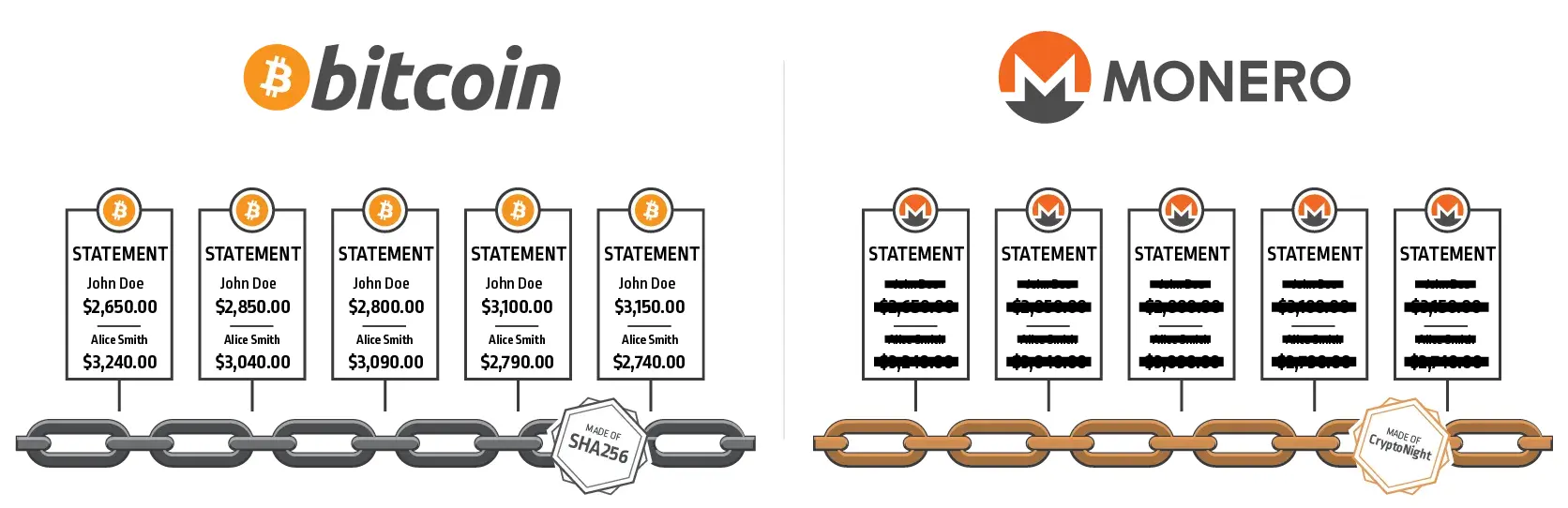
Monero combines several cryptographic techniques to make transactions private while still allowing the network to verify that no one is cheating.
Stealth addresses: hiding the receiver
When someone sends XMR, the recipient’s public wallet address is not written directly to the blockchain.
Instead, the sender creates a unique one-time address for that payment. Only the recipient can recognize and spend the output, but outside observers cannot easily link that output to the recipient’s public address.
Ring signatures: hiding the sender
To hide the sender, Monero uses ring signatures.
A Monero transaction input is mixed with decoy inputs from the blockchain. The transaction proves that one of the possible inputs is real, but it does not reveal which one.
Currently, Monero’s ring size is 16: “Ring size (16) = foreign outputs (15) + your output.”
RingCT: hiding the amount
Privacy is incomplete if transaction amounts remain visible.
Even when addresses are hidden, exact amounts can leak information. For example, a known invoice amount, salary amount, or exchange withdrawal amount can help connect transactions.
Monero uses Ring Confidential Transactions, commonly called RingCT, to hide transaction amounts.
The network can still verify that inputs and outputs balance correctly, but the public does not see the exact value transferred.
Decentralized mining with RandomX
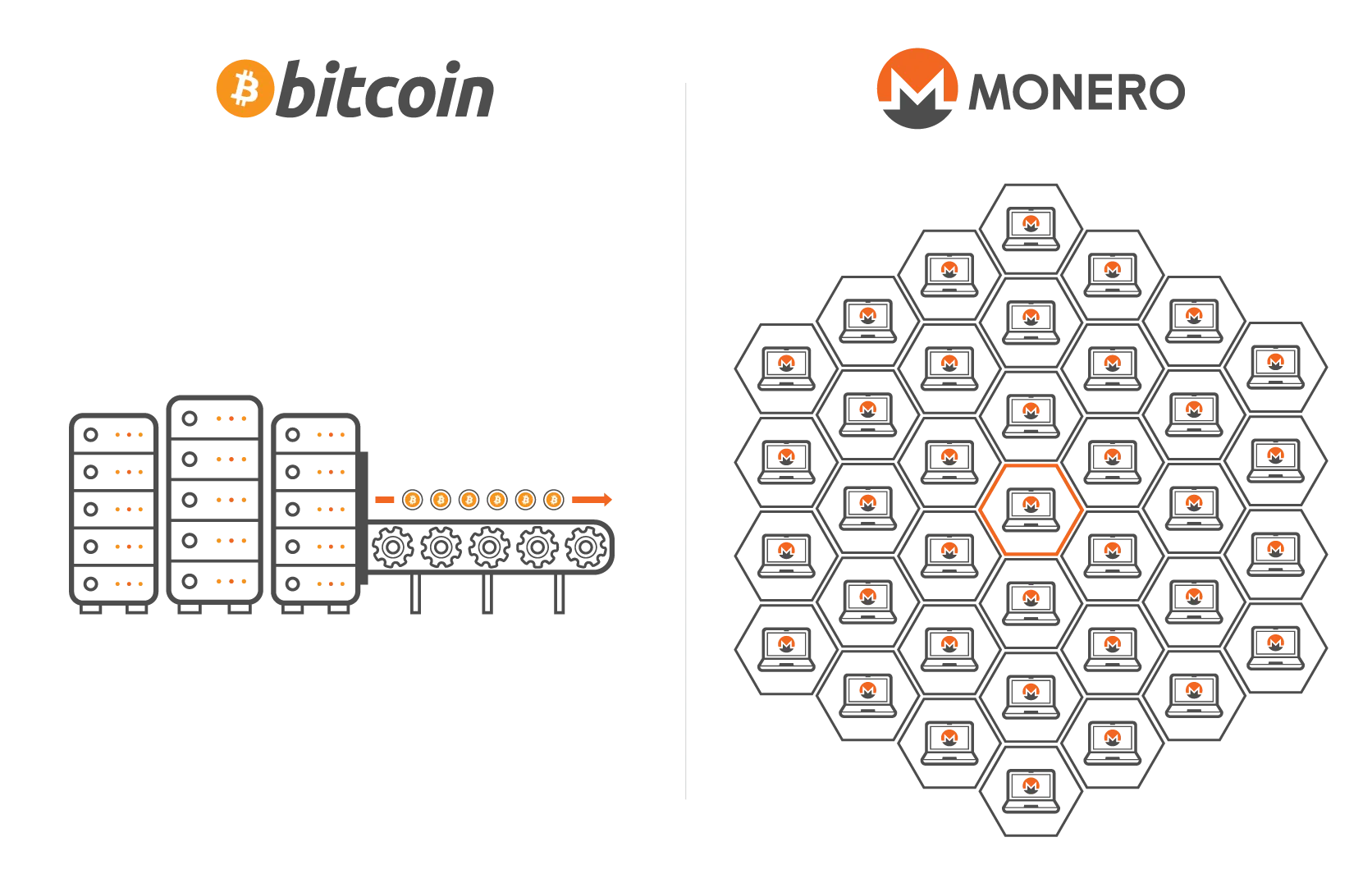 A censorship-resistant currency needs decentralized security.
Many proof-of-work networks become dominated by specialized mining hardware. When mining requires expensive ASICs, power concentrates in the hands of large operators with access to capital, cheap electricity, and industrial facilities.
Monero uses a proof-of-work algorithm called RandomX, designed to be efficient on general-purpose CPUs.
The goal is not to make mining perfectly equal for everyone. Large miners can still exist. But RandomX makes it harder for specialized hardware to dominate the network in the same way ASICs dominate many other proof-of-work chains.
Tail emission: long-term security over fixed-supply ideology
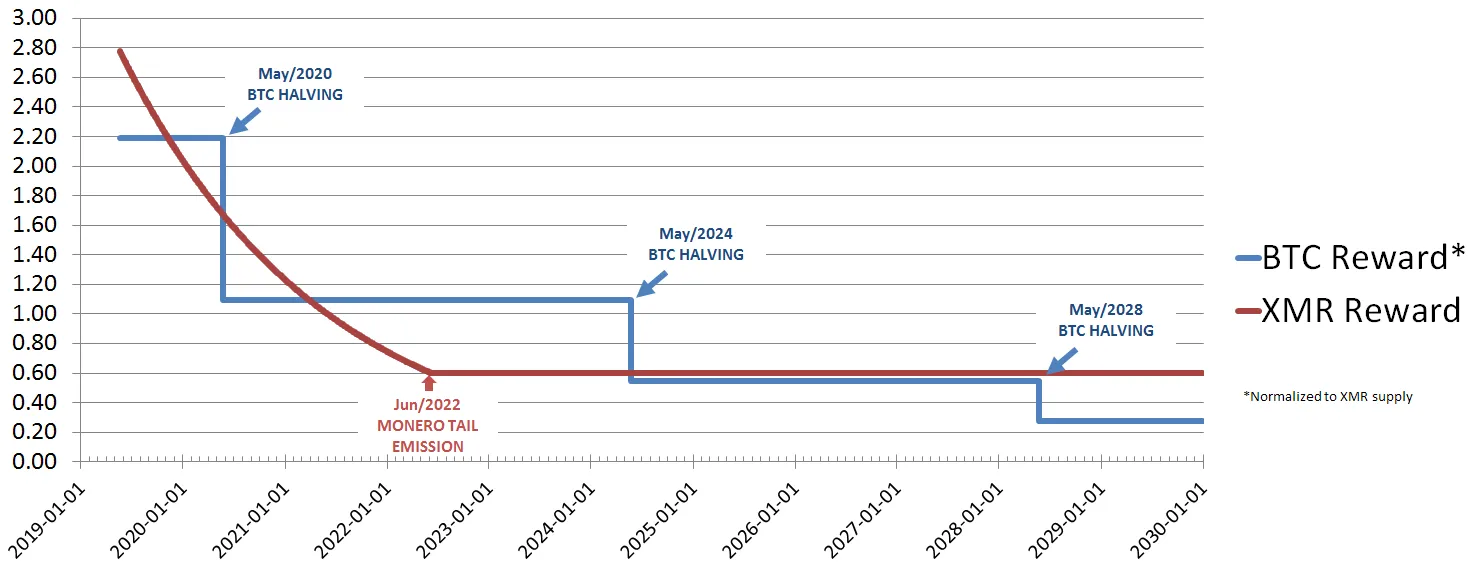 Bitcoin has a fixed supply cap of 21 million coins. Monero takes a different approach.
After the main emission phase, Monero continues issuing a small constant block reward known as tail emission. This reward is currently fixed at 0.6 XMR per block.
This has two important effects.
First, it keeps miners permanently incentivized. The network does not need to rely entirely on transaction fees for long-term security.
Second, it keeps fees more usable. If a network depends only on fees to pay miners, fees may need to become very high during periods of heavy demand or weak block rewards.
Monero chooses predictable, low ongoing inflation in exchange for long-term mining incentives.
Supporters see this as a more realistic design for digital cash.
Dynamic blocks and practical payments
 A currency must be usable.
If fees are too high or confirmation behavior becomes unpredictable, people stop using it for normal payments.
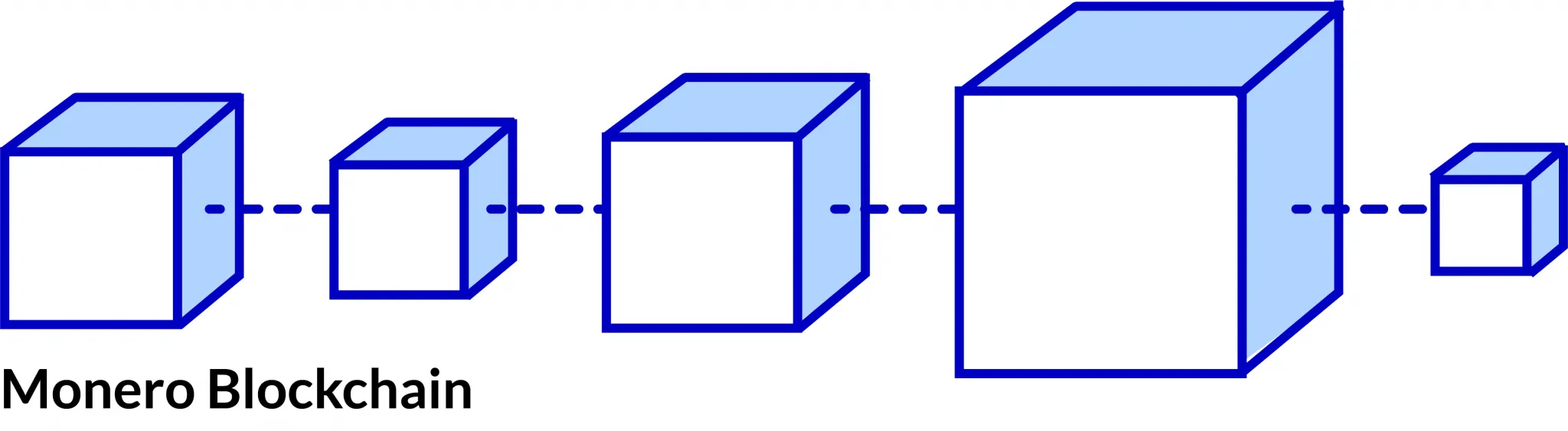
Monero uses a dynamic block size system. Blocks can grow when demand increases, but growth is controlled by penalty rules so miners cannot expand blocks without cost.
This gives Monero a more flexible fee market than rigid block-size systems.
A currency must be usable.
If fees are too high or confirmation behavior becomes unpredictable, people stop using it for normal payments.
Monero uses a dynamic block size system. Blocks can grow when demand increases, but growth is controlled by penalty rules so miners cannot expand blocks without cost.
This gives Monero a more flexible fee market than rigid block-size systems.
Wallet and node separation
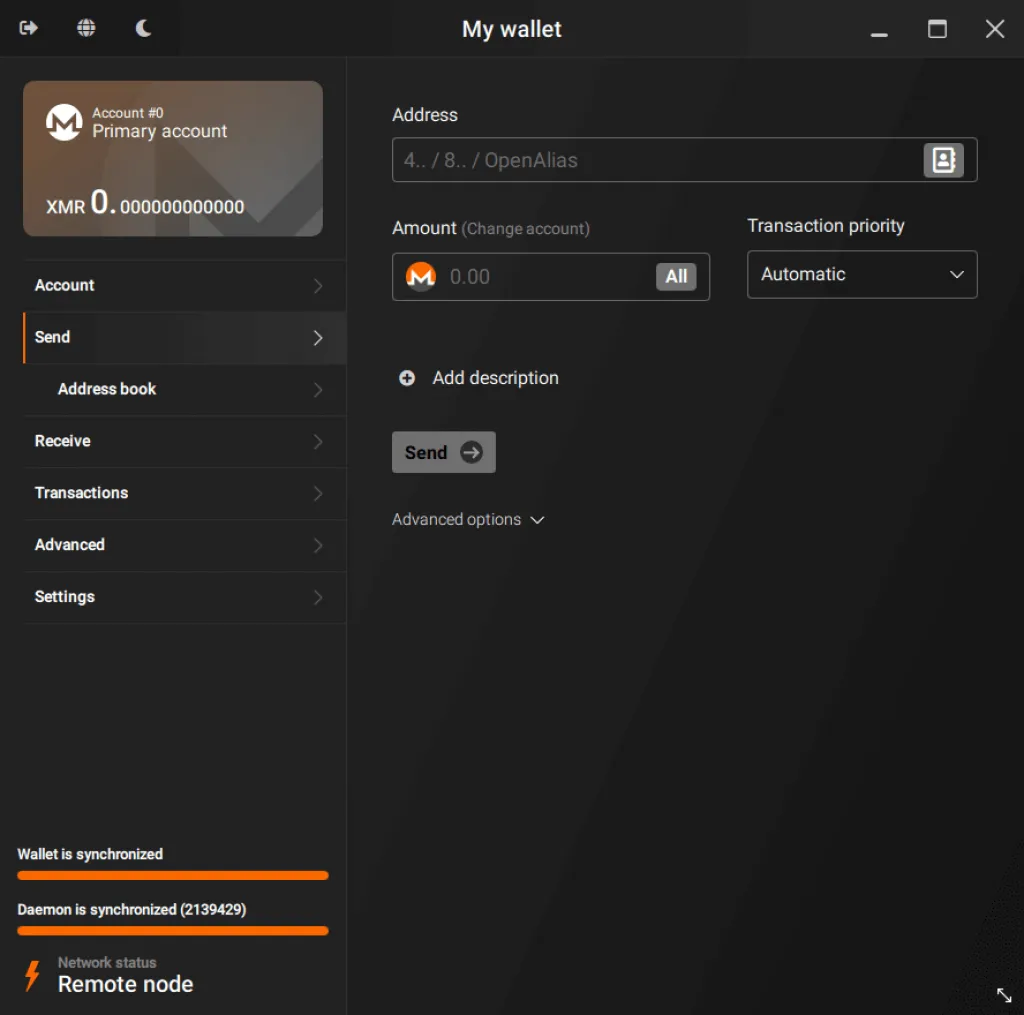 Monero separates the wallet from the node.
The node, called monerod, downloads and validates the blockchain. It connects to the Monero peer-to-peer network and relays transactions.
The wallet holds the user’s keys. It scans the blockchain, recognizes incoming payments, builds transactions, and signs them.
This separation matters because a node does not need the user’s private keys.
A user can run:
- a local node on the same machine,
- a private node on a home server,
- a node on a VPS,
- or a remote node operated by someone else.
The strongest privacy option is running your own node. A remote node cannot steal funds, but it can create metadata risks such as seeing your IP address, wallet sync behavior, or transaction broadcast timing.
Multisig in Monero
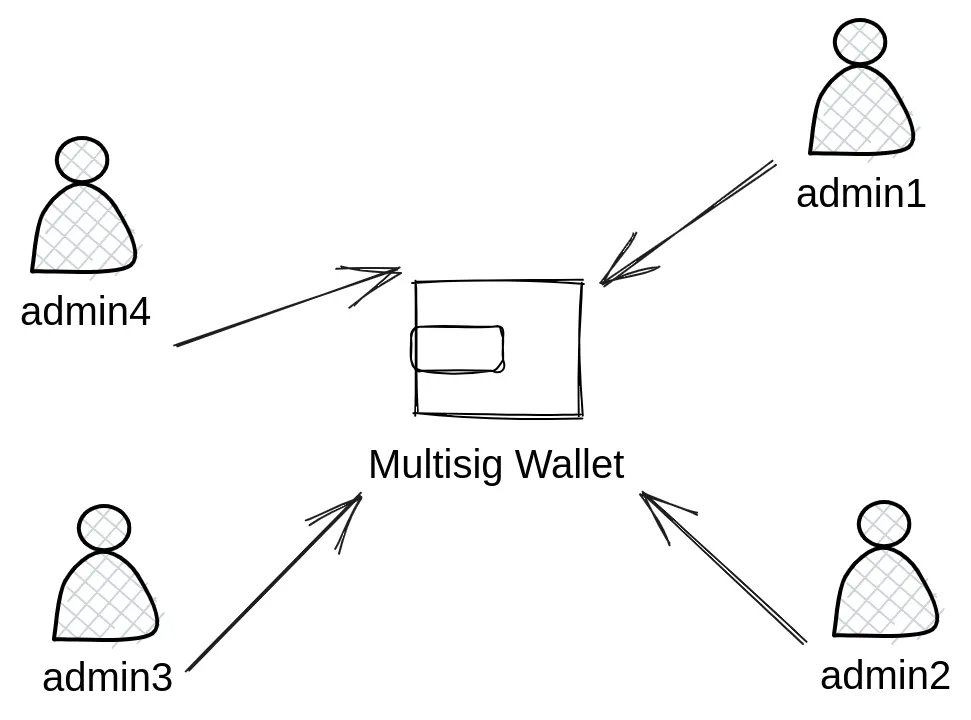
Multisig means funds require cooperation between multiple participants before they can be spent. For example:
- 2-of-2
- 2-of-3
- 3-of-5
Unlike Bitcoin, Monero multisig is not exposed as a special public script on-chain. It is handled at the wallet level through key sharing and cooperative signing.
This is useful for:
- shared custody,
- escrow,
- inheritance planning,
- high-security storage,
- business treasuries.
However, Monero multisig is more complex than normal wallets and is mainly used through command-line tools. It is powerful, but not beginner-friendly.
| Category | XMR / Monero | BTC / Bitcoin | ETH / Ethereum | USDT / Tether |
|---|---|---|---|---|
| Fees | Low. avg 0.00029 XMR / $0.104 | Variable — avg 0.0000039 BTC / $0.28 | Variable. avg 0.00008 ETH / $0.159 | Depends on chain. ETH $0.022, BNB $0.021, Polygon $0.0014, Tron $2.246 |
| Native wallet | Strong. Official GUI and CLI wallets exist. | Strong but heavy. Bitcoin Core is full-node style, secure but needs storage and sync. | Mixed. Ethereum has many self-custody wallets, but no single simple “native ETH wallet” equivalent for normal users; wallets are mostly ecosystem apps. | Weak as native money. USDT is a token on many chains, not its own native blockchain currency. |
| Privacy | Excellent by default | Weak by default | Weak by default | Weak |
| Anonymity | Easy | Hard | Hard | Very hard |
| Security | Strong for payments. Smaller attack surface than smart-contract platforms. | Very strong base-layer security. Conservative design and huge PoW network | Strong base layer, higher user risk. Smart contracts, approvals, bridges, DeFi, MEV, and phishing increase practical risk. | Technically simple, but trust-heavy. Security depends on issuer, reserves, chain, wallet, exchange, and legal controls. |
| Decentralization | Strong. No issuer; CPU-oriented RandomX mining helps keep mining more accessible. | Strong protocol, mining-pool concentration risk. Anyone can run a node, but block production is dominated by large mining pools. | Mixed. Decentralized protocol, but staking pools, L2s, RPC providers, stablecoins, and MEV infrastructure add centralization pressure. | Weak. Central issuer; not censorship-resistant money. |
| Traceability | Low | Very high | Very high | Very high |
| Ease of regular use | Good | Medium. | Medium/low | High convenience |
| Convenient for sellers | Good | Medium | Medium | Low |
| Control over funds | High | High | High | Limited. |
| Best use case | Private digital cash. | Store of value | Smart contracts | Token for trading. |
Improper Monero Usage
For all intents and purposes, Monero is virtually untraceable, but only in a vacuum, that is, within the context of Monero itself. Monero cannot protect things that are outside of itself. It cannot obfuscate real life and cannot protect your from social attacks. What you do outside of it can easily deanonymize your activities.
Always Transfer To and From Your Own Wallet
The first important thing you should always remember is to never treat any exchange as your personal wallet. The exchange has all the client-side information on that transfer including the transaction ID and private keys. A transfer from a centralized exchange is no more private than Ethereum or Bitcoin. Remember this when dealing with Monero transaction:
The sender is only as private as the endpoint from where the Monero was sent
Timing/Amount Correlation Attacks
Use amounts that aren't similar when moving your money in and out of your XMR wallet - Time those transactions as far apart as possible. - Keep your XMR within the Monero economy by using it with others who accept Monero, such as on XmrBazaar, keeping you from being exposed to centralized entities. - Trade your XMR for fiat using Haveno
Using a trusted node
The best way to use Monero is to run your own node and send transactions using that node. The next best option is to connect to a trusted remote node over Tor onion. This protects your IP address which is one of the most important pieces of info when a malicious node is trying to deanonymize users. Other pieces of info include fee structure and input/output information.
This became especially known in 2024 when it was leaked that the company Chainalysis were running honeypot nodes on the clearnet as their primary attack vector against Monero transactions
How to get your first Monero?
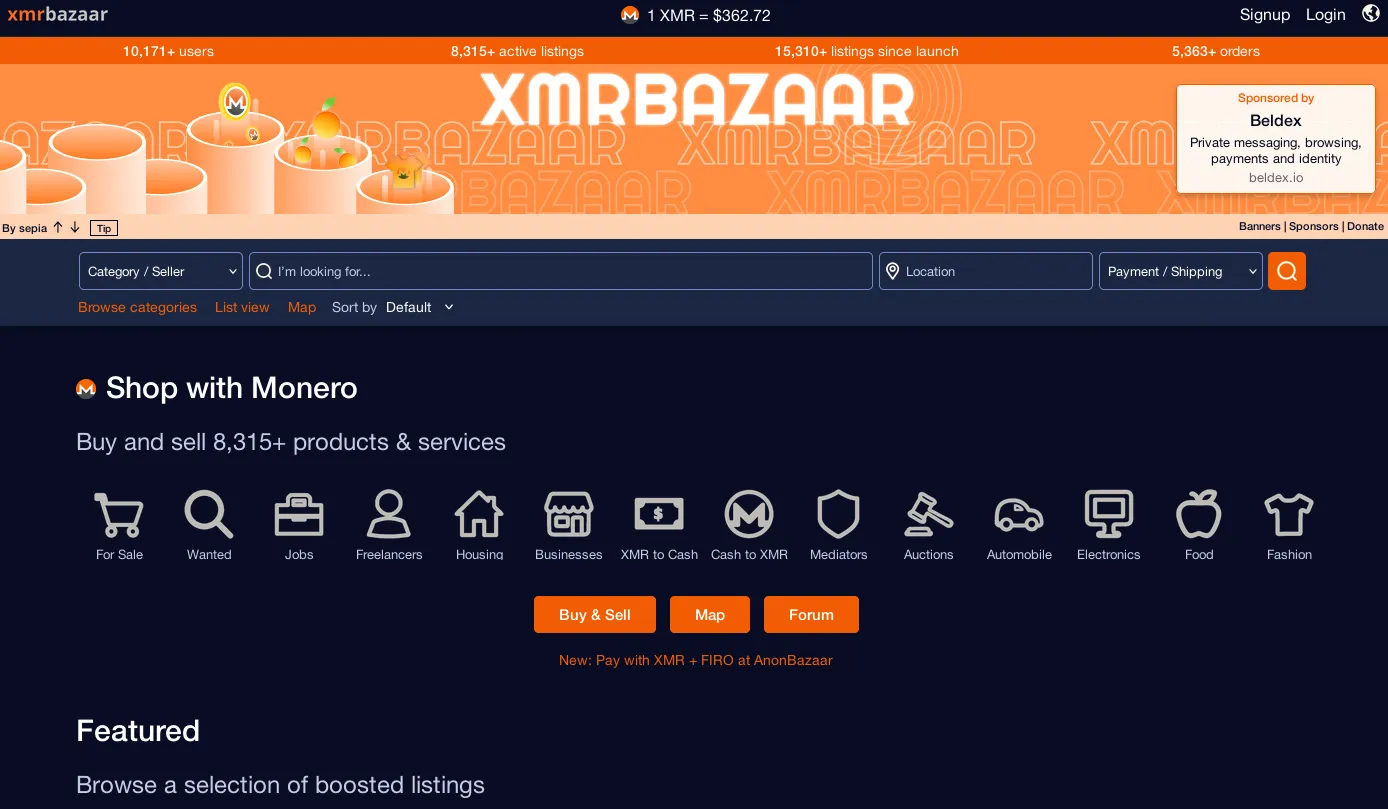 On XmrBazaar, you can sell and buy (legal) goods and services, peer to peer. You can view it as a Craigslist or eBay but using Monero as it's only currency. It's as simple as signing up there, listing something that people are likely to want to purchase (it can be video games, guitars, t-shirts, or literally just offering euros in exchange for some Monero), and with it, you'll be able to not only participate in the Monero Circular Economy, and get your first XMR in the process.
You can also get XMR through decentralized and non-custodial exchange options such as EigenWallet, BasicSwap, RetoSwap, and Haveno-based markets. EigenWallet and BasicSwap focus more on crypto-to-crypto atomic swaps, while RetoSwap and Haveno use a peer-to-peer escrow model. These tools are not risk-free: users can still face software bugs, bad counterparties or user-error losses. Still, they are important options because they reduce dependence on centralized exchanges.
Other privacy-friendly exchange options can be checked on KYCnot.me.
Monero for shops.
Monero is especially convenient for stores because payments go directly from the customer to the seller’s wallet, without banks, card processors, chargebacks, frozen merchant accounts, or withdrawal approvals. Fees are low, payments are global, and the seller can accept XMR with a normal wallet, QR code, or payment request. Unlike transparent cryptocurrencies, Monero also protects business privacy: competitors, customers, and chain-analysis companies cannot easily see store revenue, supplier payments, wallet balances, or client activity.
Monero is also convenient from a developer side. The wallet and node are separate parts: the wallet holds keys and tracks payments, while the node only provides blockchain access. This means a store does not need to run a full Monero node on day one, which is useful if the merchant does not have a server with enough disk space for the blockchain (200 Gb). A shop can start with a remote onion node, then later move to its own private node for maximum privacy and independence.
Monero also makes secure payment gateways easier to design. If the server only needs to detect incoming deposits, it can use a view-only wallet. A view-only wallet can see payments, generate addresses, and monitor balances, but it cannot spend funds. So even if the web server or payment backend is hacked, the attacker cannot withdraw the store’s XMR. The spend key can stay offline, on a separate machine, or in a hardware wallet.
Conclusion: Monero is the clearest digital cash project
 Monero is not only a technical project. It represents a political and philosophical position. Without financial privacy, people can be watched, profiled, censored, excluded, or punished. Transparent finance gives power to whoever controls the surveillance layer. This does not mean privacy eliminates responsibility. It means financial privacy should be normal, not suspicious. Cash already provides this in the physical world. Monero tries to provide it online.
Thank you for reading this article. You’ve likely learned something new and useful.